
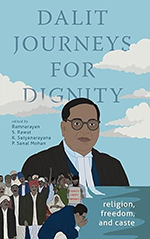
This is the much awaited second volume of Dalit Studies, succeeding the first published in 2016. While each of these is autonomous, they are both part of an ongoing project. Dalit Journeys for Dignity is a hugely significant book on two seminal counts. Not only does it cover fresh ground in offering a granular understanding of the many challenges embedded in the social experience of Dalits but also articulates the different modes of resistance to these in the essays included in the volume, a majority of which are written by young Dalit scholars. The contributing essays zero in on the embodied and situated Dalit struggle for dignity and self-respect, drawing attention to how historical instances of assertion against everyday discrimination in social, religious and economic interactions shape the contemporary fight for equality. Documenting from the ground, as it were, the essays cover a range of often little-known actors who resisted entrenched caste practices and inaugurated movements for dignity, all of which informs the conceptual category: Dalit social.
In their ‘Introduction’, Rawat and Satyanarayana unpack the concept of the Dalit Social: social democracy as distinct from political democracy, and the historical and ongoing fraught struggle for dignity, self-respect and equality. This substantial piece works with close reference to Ambedkar’s many writings and speeches that stress on the term ‘dignity’, culminating in its significant presence in the Preamble to the Constitution. It notes Ambedkar’s rejection of both the Western philosophical tradition which associated ‘dignity’ with human reason, as well as of Hinduism, where it constitutes status and hierarchy. As we know, Ambedkar saw this quality of human value in traditions that spoke of compassion and fraternity. While he spoke of ‘manuski’ in the poetry of medieval saint poets in Marathi bhakti literature, he was to find it ultimately in the Buddhist doctrine of ‘maitri’: empathetic fellow-feeling which is the basis of a just social order, ensuring dignity to all human beings.
Ambedkar understood that only legal sanction, important though it was, was never going to be a foolproof and sufficient foundation to guarantee equality and dignity for a structurally marginalized and discriminated section of society.
‘Democracy’, he said famously, ‘is only a top-dressing on an Indian soil, which is essentially undemocratic,’ pointing with unerring accuracy to the limitations of institutional safeguards that could only ever partly empower Dalits. The Introduction notes Ambedkar’s insistence on the necessity of ‘moral stamina’, the relentless fight which Dalits must wage, not just in the political sphere, but crucially in the realm of the social in order to secure their right to dignity. Besides religion and education which ostracized them, the social arena also includes all those basic amenities which were/are systematically denied to the Dalits, such as freedom and dignity in access to food, housing, personal grooming, leisure and the right to privacy. The editors discuss the impact of Ambedkar on the Dalit community as presented in Dalit life-writing, especially in Marathi autobiographies. Baby Kamble’s vivid narration of her life in The Prisons We Broke (1986) memorializes the sub-human living conditions of the Mangs and Mahars, and the revelatory influence of Ambedkar, who is seen in a cameo, on the consciousness of Dalits.
Given the thematic engagement of the book, the essays grouped in the first section focus on religious conversion to other non-Hindu faiths or the initializing of new devotional movements that are pivoted on the rejection of inflexible caste practices and the affirmation of self-respect and dignity. Chakali Chandra Sekhar’s paper brings to life, from sparse archival sources, the fascinating figure of Nanchari, a Dalit weaver and cotton seller who in the year 1838 converted to Christianity and left the legacy of a mass conversion movement amongst his community of Mala Dalits. Nanchari was imprisoned for attempting to enter a local temple. While in jail, missionary records show that he had a series of conversations with a Christian priest. Nanchari is remembered to have said, ‘I went to Ahobilam temple in search of God, but was imprisoned. Yet this new God, Jesus Christ, came in search of me.’
In the second essay, Ramnarayan S Rawat demonstrates the significance of the 16th century Dalit saint-poet Ravidas, whose legacy inspired the Chamar led Sant-Mat community of north India in the 1920s to seek paths to dignity. Through the mediation of the spiritual leader Swami Achutanand, who put together a body of devotional literature in Hindi dialects familiar to Dalits and connected the idea of equality espoused in devotional literature with modern notions of equality and rights, Sant-Mat Dalit communities envisioned an anti-caste platform and a language of self-respect. The subsequent essay by Koonal Duggal also focuses on Ravidas in whose memory the Dalit Sikhs in Punjab mobilized themselves in the Ravidassia movement which has found a huge following amongst Punjab’s Dalit diaspora. Duggal teases out the fault lines in the larger Sikh community in Punjab out of which emerged the Ravidassia sect. The assassination of Sant Ramanand in Vienna in May 2009 while addressing a congregation of devotees marked a point of severance. In 2010, the leaders of the community declared the Ravidassia movement to be an autonomous religion. Duggal’s essay is particularly illuminating in highlighting the deployment of new digital media and hyper-masculine Punjabi Jat music in the cosmopolitan celebration of Saint Ramanand.
Lucinda Ramberg’s intriguing study is located in the inner spaces of Karnataka Buddhist families and the compromises which the women make in the family’s self-fashioning. If images of the Buddha and Ambedkar adorn the outer spaces, in the inner sanctum women worship the family deities which they have inherited from their maternal families. Even as the men berate the women asking them to effect a radical break with the past, they too reproduce the social structure by adhering to endogamous marriages. While these acts can be seen as contradictions, says Ramberg, it is also possible to see them as ‘forms of transformative reproductive labour and history in the making’. Justin T Verghese positions his work amongst Dalit Christians in Kerala, examining in granular detail the challenges posed by the conservative elite Syrian Christians. With the intervention of a committed Jesuit priest, the Dalit Christian community was able to establish a new Catholic faith. His study concludes on an affirmative note by demonstrating how Dalit Christians in Kerala, by dint of the practice of Christian values despite the humiliations and indignities heaped on them, democratized and truly Christianized the Church.
The second set of essays in the volume are grouped around challenges to occupational, spatial and sartorial practices, and Dalit initiatives to reimagine history. In her essay titled ‘Presenting the Dalit Body’, Anupama examines the impact of British colonialism and the opportunities the new liberal order held out in conceiving a transition to a dignified personhood. She covers substantial ground to show how clothing denotes ‘identity transformation, selfhood and social defiance—especially in rural contexts’ led by the example of Ambedkar’s own sartorial choice. Sharika Thiranagama’s study, ‘Inheritance and Caste Formations in Kerala’ draws from her impressive fieldwork amongst female agricultural labourers belonging to three Dalit communities across a few districts in rural Kerala. The detailed ethnographic elements in her work show how ownership of a pukka home, education and new ideas of work are critical to Dalit communities. More often than not, it is women’s income and work which are central to agricultural households, and it is their aspiration which is the driving force for dignity and self-respect.
‘Caste, Occupations, and (Im)mobility in Modern Indian Industry, 1870-2006’ by Sumeet Mhaskar is an incisive analysis, based on painstaking empirical data, which repudiates the thesis that large-scale manufacturing industries and rapid modernization weaken the caste structure in cities. Through his focus on employment patterns in the Bombay textile mills, Mhaskar shows how ‘caste-based occupational norms shaped occupational choices in modern manufacturing industries in Mumbai city’. His analysis reveals that Dalits were restricted to the least desirable jobs and prohibited from moving into the most desirable occupations. The last paper in this group of essays by Dickens Leonard traces the anti-caste hermeneutic of the late 19th century Dalit intellectual Iyothee Thassar and ‘his writings on the history of India as a textuality against caste and Brahminism’ where he demonstrates the egalitarianism of Buddhism, which is shown as a community open to sharing, as against Brahminical exclusivity. Leonard’s detailed exploration of the writings of Thass notes a similarity between Jotirao Phule and Iyothee Thass, two modern anti-caste thinkers who foreshadow Ambedkar and Periyar.
The essays included in Dalit Journeys for Dignity inaugurate fresh ways of understanding resistance to caste discrimination, and novel themes in the study of caste and untouchability in South Asia. The volume breaks new ground and emerges from deeply committed engagement with the changing contours of caste as it operates in India, and as such will prove to be an indispensable study to scholars and activists in the field.
Rohini Mokashi-Punekar teaches at the Department of Humanities and Social Sciences, Indian Institute of Technology, Guwahati. She is the author of On the Threshold: Songs of Chokhamela (Altamira Press 2005 and The Book Review Literary Trust 2002), Untouchable Saints: An Indian Phenomenon (Manohar 2005) which she co-edited with Eleanor Zelliot, Vikram Seth: An Introduction (Cambridge University Press 2008), and The Third Eye and Other Works: Mahatma Phule’s Writings on Education (Orient BlackSwan 2023).