
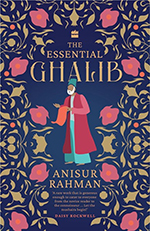
Mirza Ghalib is arguably the most popular of Indian poets. Despite his meagre poetic output in Urdu poetry, his popularity transcends class, gender, educational or literacy levels. Be it a mundane, everyday situation or a deeply passionate one, people will be found spouting Ghalib, turning him almost into a metaphor. ‘Ghalib ka bachcha’ is a metaphor that will generally be understood to mean an aspiring poet or someone having similar pretensions. Even the political classes in India, not particularly known for their love of poetry, find him irresistible, his verses reverberating in the two houses of Parliament, recited even by those who might have no taste in poetry in general, and might even be anti-Urdu in their political stances. Quite easily, we can designate him ‘essential’ as Anisur Rahman does, though not exactly in this sense. However, for the impact and appeal of the verses to be driven home, the verses have to be delivered in Urdu. Will there be the same number of listeners in the Indian Parliament and elsewhere if the verses are recited in English translation? The answer is a no-brainer. So much for poetry in translation, specifically, Urdu poetry in English translation, and that, too, rhyming poetry! We will turn to this in a moment.
The only other Indian poet who can rival Ghalib both in popularity and substance is certainly Rabindranath Tagore, whose corpus easily ran into ten times over Ghalib’s. Although separated by more than half a century (Ghalib died barely eight years after Tagore was born), they had quite a few things in common. A significant section of their poetry has been put to music and sung wherever the speakers of the two languages happen to be, ensuring their enduring appeal. Both of them were supremely confident of their appeal to posterity; if Tagore imagined his readers reading him eagerly even a hundred years hence in his poem, Aji hote shotoborsho parey (One Hundred Years from Today), Ghalib characterized himself as someone who could be properly comprehended by readers yet unborn (Hoon garmi-e-nishat-e-tasavvur se naghma-sanj/ Main andaleeb-e-gulshan-e-naa-aafariidah hoon— ‘I sing with the excitement of the joy of the things I imagine and foresee/ I am the nightingale of the garden that is yet to be born’). If Tagore was central to the Bengali self-fashioning in the twentieth century, Ghalib and Iqbal had the same centrality in the Urdu elite’s self-fashioning during the same period. Tagore ventured into painting late in life, producing about 2000 works of surreal beauty, some of them may be interpreted as extensions/interpretations of the themes he dealt with in his poetry and fiction. Ghalib was no painter himself but inspired painters (and sculptors too), the most notable of whom was the legendary Abdur Rahman Chughtai who produced a series of paintings known as Muraqqa-e Chughtai, works of incomparable beauty and exquisite charm that interpret individual shers of Ghalib.
These painting may also be treated as translation, not interlingual but inter-semiotic translation where the form changes, from words to lines and colours but the interpretation may be said to have as much validity as it has in interlingual translation.
And finally, Ghalib and Tagore never disappoint their readers whatever state of mind or situations they are in; there will be some verse or the other to celebrate the mood of jubilation or find solace in despair or misfortune. But all this will work better when you can enunciate the verses in the original Urdu or Bangla, not in their English version.
The above preamble is intended to prepare a context to answer the question: how can one appreciate poetry in translation? There is no universal rule regarding translation of rhyming poetry between distant languages, as Urdu and English are. More often than not, translators content themselves with paraphrasing the original in prose and supplementing it with commentary, because they justifiably think that attempting translation into corresponding rhymes will involve making too many compromises and dilution of the content. As far as Urdu is concerned, it is further compounded by the fact that Urdu ghazal continues to be a product of the oral tradition where the shers are produced primarily to be recited or sung (not exactly, but somewhat like Rabindra Sangeet and Nazrul geeti) where the meaning/interpretation differ radically with emphasis on certain syllables or variations in intonation. As a genre, ghazal poetry is performative, highly conventional and its public recitation (mushaira) is governed by an elaborate protocol that has evolved over centuries. The poet does not recite the two lines of a couplet in quick succession; he will recite the first line, often making a proposition, then there will be a meaningful pause, allowing for repetition and appreciation by the audience through wah wah and mukarrar, and then when the suspense is at its apex, deliver the second line almost like a punch that will bring the proposition to a logical end, even though that logic may, sometimes, be far-fetched. How a translator in English can even begin to suggest, let alone preserve, all these nuances in his translation? Ralph Russell of SOAS who, through his life-long collaboration with the redoubtable Urdu scholar Khurshidul Islam, produced a significant body of work on Urdu poetry and Ghalib (Ghalib: Life and Letters, Three Mughal Poets, The Famous Ghalib, etc.) including translation of Ghalib into English, opined that English has far fewer rhyming words than Urdu, and therefore it is difficult to recreate the musicality of Urdu ghazal in English. Phonetically, Urdu is one of the richest languages of the world, drawing as it does from both the Arabo-Persian and Indic sources. Its sheer musicality draws audience to it irresistibly, as evidenced now by its growing popularity in the internet space. But the same musical resonances cannot be produced in English translation. Frances Pritchett, a life-long scholar of Urdu poetry in Columbia University relates how she read several translations of Ghalib’s poetry in English, each one of which left her cold and dissatisfied, and she felt ‘Aha, the world waits for my translation of Ghalib’s divaan that will be perfect!’ But when she actually got down to translate and wrestled with the craft, she realized how challenging the task was! So, now, we do have her published translation by her; what we also have is the most comprehensive compendium on the commentary of Ghalib’s ghazals online (A Desertful of Roses, https://franpritchett.com) where the interpretive history of the verses and their original sources have been organized in the most reader-friendly way. Certainly a work of meticulous scholarship that will have enduring value!
Despite the hurdles enunciated above, if a translator still ventures to translate Ghalib in rhyming poetry in English, as Rahman does, he must first be congratulated for his audacious courage. Only someone who is passionate about both poetry and Ghalib, and fully confident of his craft would attempt to do so. Rahman selects 200 verses from the entire divaan running into 235 ghazals. He doesn’t mention his principle of selection, so one assumes that it is purely a personal choice. The selection is neither chronological nor thematic, as usually such selections are. He also doesn’t mention the nuskha or edition he uses for his selection. After selecting a particular verse in the Urdu original, he gives its Nagari version and then the Roman transliteration, followed by the dictionary meanings of all the difficult words/terms. Once these are done, which give the reader a flavour of the original, he gives his verse translation in English, sometimes in a corresponding couplet, sometimes in a quartet. On the facing page of this verse he then presents a fuller explanation of the verse, its general import/intent, significance of poetic devices like similes, symbols and metaphors used and so on. This mode of presentation is reader-friendly, and caters to different levels of readership. Rahman gives us a little more, often supplying a range of parallel verses on the same theme from Ghalib himself, and from other Urdu and English poets. Thus, while reading Ghalib the reader hears echoes from Mir, Dard, Momin, Dagh, Zauq, Firaq, Muneer Niazi, Siraj Aurangabadi, Shahryar on the one hand, and Shakespeare, William Blake, John Keats and Robert Frost on the other. They constitute Rahman’s referential universe that gestures towards a world republic of poetry that extends the range and deepens the reader’s understanding of Ghalib.
Rahman gives us some glimpses of his method as a translator and commentator as follows:
Apart from unraveling the Ghalibian ambiguities for myself, I also needed to develop a translation methodology for my individual purposes. I realized rather naturally that I needed to develop a linguistic register and a pattern of rhyme and rhythm in the English language that could represent both Ghalib’s intent and his tone of voice…(Preface, p. xvii).
However, as I hinted earlier, the moment a translator decides to translate an Urdu couplet from a ghazal into a certain rhyme scheme in English, he puts himself into a trap. After he translates the first line of the verse, his whole attention is concentrated on finding an English word or phrase that will rhyme with the earlier line. At this point, he has to be ambidextrous–how much content to sacrifice to get the rhyme and rhythm in place? The twin process of insertion and deletion will come into play. His capability to evenly balance the demands of content and form will determine the quality and ‘authenticity’ of his translation. For an illustration let us look at verse 10: (p. 20) in the present collection which runs thus: bu-e gul, naala-e dil, dood-e chiragh-e mehfil/jo teri bazm se nikla sau pareshaan niklaa. This verse has been rendered into English by Rahman as Flower’s fragrance, heart’s wailing, /assembly’s lamp smoke–all for nought/Whoever came out of your assembly/came out distraught. It is evident that ‘all for nought’ is an insertion on the part of the translator which is not there in the original. Now, let us try to imagine the mushaira in which the verse could have been recited by the poet. The first line in Urdu merely enumerates three widely disparate entities–fragrance of flowers, wailing of heart and the smoke rising from the lamp in the mehfil. When the first line was recited, the audience must have felt puzzled, looked at each other in bewilderment, repeating the line among themselves (as the convention of a mushaira is) wondering all the while the punch Mirza Nausha was going to deliver in the second line. The poet must have enjoyed the nail-biting suspense that would have descended on the audience where everyone was waiting for the second line with bated breath. In fact, the suspense continues till the first half of the second line. It is only when the poet came to the word ‘pareshan’,the audience, with the sudden shock and joy of recognition, must have broken into a thunderous applause. Now, the insertion of the phrase ‘all for nought’ which was a demand of the rhyme, has diluted, if not totally spoiled, that impact. It is no weakness of translation, but inherent in the method the translator has chosen for himself. We can juxtapose Rahman’s translation alongside the translation of the same verse by T P Issar, another Ghalib translator in English who follows the same format (Urdu original, Hindi transliteration, Roman transliteration, English translation) in his highly embellished volume in coffee table format that uses Chughtai’s paintings for illustrations:
The flower’s scent; the candle’s smoke;/ the lament of aching heart/Being with you, and then having to leave;/ no wonder they are distraught.[1] Here the translator substitutes the entire phrase ‘the smoke rising from the lamp in the mehfil’ with simply ‘the candle’s smoke’ resulting in cultural attenuation and muted resonances of the original. Again, not entirely the translator’s fault, because it stems from the method he has chosen for himself. The moral is : if we love a great poet but cannot read him/her in the original we must read not one but several translations to arrive at a fuller understanding of the poet. If one translator misses one aspect, another translator might compensate for it. This is what happens in practical life. When one reads Tagore, Dante, Goethe or Baudelaire in English one knows which translator, out of many, one should go to. One does not randomly pick up any version in English. While translating Ghalib the translator should also keep in mind the fact that for the cerebral poet that Ghalib was, poetry is maa’ni afreeni (meaning-making) and not simply qafiya paimayi (measuring rhymes).
I would have loved to discuss some more couplets but for the constraints of space. However, before I conclude I would like to point out a couple of things. One, the personal pronoun ‘hum’ (we) in Urdu has invariably been translated by Rahman as ‘I’ in English translation. Even after making allowances for the convention in Urdu, I genuinely feel that this preponderance of ‘I’ in the English version might persuade unsuspecting readers to read Ghalib’s biography in his poetry, forgetting the fact that the poetic lover-persona in Urdu ghazal is an artificial construction, a convention that goes back forever. ‘Hum’ could have been translated as ‘we’ in several cases to represent the intent better. Two, the word ‘barq’ in many places (pp. 28, 29, 34, 35, 128…) has been rendered as ‘lightening’ rather than ‘lightning’. Must be a typo that should be corrected in the next edition of the volume, because Ghalib certainly wouldn’t like ‘lightening’ of his verses in any sense of the term. Three, a thematic index and a first-line ready reckoner would have helped readers locate the verses easily. Finally, though Rahman has devoted (half of the space) in the book for commentary, in the entire space there is not a single reference to the magnificent commentarial tradition of Ghalib’s poetry in several languages. The ‘Foreword’ by Vinay Dharwadker may be said to have partially filled this gap, but only partially, because it refers to only a small segment of that tradition, and that too only in English. The larger archive of commentary in Urdu and Hindi remains unacknowledged. Even small gestures to that archive would have opened new possibilities of interpretation for discerning readers. No commentator on Ghalib at this historical juncture can act as if he is writing on tabula rasa, because he is really writing at the back of an interpretive and commentarial tradition that is enormously rich in depth and plenitude. And it hardly needs emphasis that we foster scholarship by acknowledging our predecessors, and providing entry points for our successors, to take the torch forward.
M Asaduddin, author, critic and translator can be reached at asad0468@gmail.com