
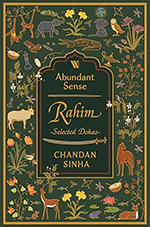
This response to Abundant Sense is not really a review but a reader’s response to an artefact and its contents, and the hours of reading pleasure that it gives, as one goes back to a favourite section frequently, or to one that seems to suit a particular moment in the minutiae of life.
Let me begin with the look and feel of the book–the hard cover which protects and encases the soft, almost diary-like pages within is a very good choice, as this is a book that will be frequently opened and re-read, and so needed this kind of a carapace. The cover is exquisite, with the choice of colours and the tiny images that give the reader the experience of discovering (or rediscovering) the delights of miniature paintings at a time when we are constantly bombarded with larger than life, loud and garish images. After reading the dohas the first time, I was impelled to go back to the cover to study it again, this time with a mental magnifying glass, as I realized and discovered to my delight that each image, even the tiniest, was metaphorically and literally reflecting and anticipating the rich and complex symbolism of Rahim’s oeuvre.
The extensively and admirably researched introduction not only serves its stated purpose of introducing Rahim’s time, place and persona to readers like me who may not be familiar with all the fascinating details of the multiple contexts and sites from which these dohas emerge and must be read to be fully understood; it also raises the curtain on the poetic adventure to follow. The thirty human feelings, actions and experiences that the dohas have been divided into Affectation, Unsound Beginnings, Bravery, Maya, Friendship, Good Conduct, Prudence and Speech, to name a few. It is a very imaginative access to Rahim’s repertoire and allows the reader to choose which individual emotional taxonomy to follow and read the poems in that order–that is what I did and this has made the experience of the book both personal and very meaningful.
Now, for the experience of each doha. The writer and translator must be commended for first giving the original in the Devanagari script for those of us who can read it, and have hitherto only read Rahim in Hindi classes and textbooks in school. My personal experience of Rahim in school was memorizing the doha on the teacher’s instructions, glossing it (using rote learned notes) for the exams and moving on. Thanks to those memory exercises, I can still quote some of the dohas. However, I cannot say that I ever engaged with Rahim at a deeper sense before Chandan Sinha’s book, and it is only now that Rahim’s immortal dohas make ‘Abundant Sense’ to me, and I have been shamelessly showing off by reciting them on apposite occasions to admiring friends, to whom I have of course recommended the book.
The translations are magnificent and I am full of respect for the creative and intellectual effort as well as the deep connection that the translator must share with Rahim to pull off this feat. Being a lover of poetry, I must admit that I approached the translations with some initial scepticism as one has encountered a whole spectrum of poetic translations (especially into English from Hindi) and many of them are banal at best and execrable at worst. But these read so pleasantly to the mind and ear that I am happy to acknowledge their poetic merit in their own right. Another outstanding feature of this particular collection is the fidelity of the translations in sense, meter and rhyme. As the author clarifies in the introduction: ‘The challenge is one of unpacking a number of ideas, concepts or thoughts from one short line in Hindi of twenty-four maatras and repackaging them into a line of English in a coherent, pleasing and metrical form.’ Chandan Sinha has surpassed this quest and done poetic and respectful justice to the original in all its creative dimensions.
It would be apposite to quote one of my favourite self-reflexive dohas here, in Chandan’s translation:
Couplets comprise a few letters, but hold abundant sense; as the crouching acrobat, Rahiman, springs atop the fence.
Each doha, whether read in the original or in English, spoke to me with equal fervour and like all good poetry does, yielded a greater wealth of meaning on each reading. This has been helped in no small measure, by the interpretation/explanation of each, which serves as a very useful starting point to engage with the doha, have the pleasure of sharing the author’s take on it and then going on to explore its myriad meanings on my own. And then, to quote Rahim, these dohas ‘blaze, again and again’.
Abundant Sense is a shining jewel in the crown of my poetry collection, where it holds pride of place and my well-thumbed copy demands that I keep it close and turn frequently to the wit and wisdom of Rahim at the multiple crossroads that one encounters in life’s journey.
Anjana Neira Dev is a Professor at the Department of English in Gargi College, University of Delhi, Delhi.