
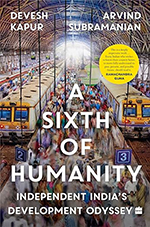
This 760-page book is a reflective and thoughtful examination of India’s unique development journey. Inspired by Ramachandra Guha’s India After Gandhi, authors Kapur and Subramanian bring an economic and institutional perspective to the story of modern India. Rather than presenting India as a straightforward success or failure, they explore the country’s complex efforts to build a modern nation while balancing democracy, diversity, and development.
The book examines the four major challenges India faced after Independence: building a capable state, ensuring economic growth, reshaping society, and forging national identity in a multi-ethnic, multi-religious and multilingual environment. It highlights that India chose to do all this within a democratic framework from the very beginning, giving every adult the right to vote, even when most were poor and illiterate. That decision, along with proactive affirmative action policies aimed at uplifting disadvantaged communities, set India apart from all other major national transformations—including those experienced in ‘the West’, where political inclusion came long after economic growth had already taken place, and those of Russia and China, which involved large-scale, forced, deliberate human costs. The authors then highlight how our unique sequencing—shaped by both circumstance and design—has, over time, resulted in a development pattern characterized by a high reliance on high-skill services, such as IT, even as manufacturing remained relatively subdued. They don’t set out to pass judgment or offer solutions. Instead, their goal is to present a layered narrative that encourages readers to think deeply, question assumptions, and explore the complexities of India’s transformation.
Throughout the book, the authors examine three big themes: how early decisions created both opportunities and challenges; how the design and functioning of India’s institutions often mattered more than political ideology; and how the success of elite sectors like IT and finance has not always translated into broader inclusion in areas like health, education, and jobs. The book is rich in research, drawing on over 700 sources and featuring a 40-page bibliography, and provides a blend of economic analysis, institutional critique, and a wide-ranging historical context.
Devesh Kapur got his Ph.D. from Princeton and began his academic career at Harvard, later teaching at the University of Texas at Austin and serving as Director of the Centre for the Advanced Study of India at the University of Pennsylvania. He is now Director of Asia Programs at Johns Hopkins SAIS. His major works include Diaspora, Democracy and Development and Rethinking Public Institutions in India.
Arvind Subramanian began his academic journey at St. Stephen’s College, followed by IIM Ahmedabad and the University of Oxford, before joining the International Monetary Fund, where he served as Assistant Director in the Research Department. He later became a Senior Fellow at the Peterson Institute for International Economics and taught at Harvard’s Kennedy School.
From 2014 to 2018, he served as Chief Economic Advisor to the Government of India. Following this, he joined Ashoka University as a Professor and Founding Director of its Centre for Economic Policy. He is currently a Senior Fellow at Brown University’s Watson Institute. His books include Eclipse: Living in the Shadow of China’s Economic Dominance and Of Counsel: The Challenges of the Modi-Jaitley Economy. Although both are currently based in the US, their careers have been closely tied to India’s policy and academic landscape, providing them with the perspective and experience to critically examine the country’s development path.
The book’s insights and analysis unfold across eighteen substantive chapters, each offering a distinct lens on India’s development journey grouped into five parts. While a detailed treatment of every chapter would be ideal, the breadth of material makes that impractical within the word limits permitted for book reviews. As such, what follows is a thematic synthesis—an attempt to capture the book’s central concerns and underlying narrative by drawing together its most compelling ideas and arguments, visiting each of the five parts in turn but admitting that this may not do full justice to the wealth of data and analysis contained in the book.
The first part of the book, ‘Origins and Order’, explores the foundational choices made at the time of Independence in two chapters. India’s leaders opted for a system in which the Central Government held greater authority than the States—a decision shaped by the trauma of Partition, the need to manage deep social and linguistic diversity, and the imperative to forge a unified national identity. The Constitution reflected this centralizing impulse, granting the Union extensive powers over legislation, finance, and emergencies. This design was seen as essential for stability and development, given the weakness of regional institutions and the colonial legacy. Yet it also created a Hobbesian paradox: the state needed enough power to govern effectively, but had to operate within democratic constraints that limited its coercive reach. This trade-off helped India survive its formative years with remarkable stability (both economic and social, as discussed in relation to various global indices, including inflation rates) but left behind enduring tensions in Centre-State relations. The authors also trace how India built its core institutions—the civil service, judiciary, and electoral machinery—and how federalism evolved in a country marked by linguistic, cultural, and geographic diversity.
The second part, ‘State, Markets and Economy’, comprises five chapters that offer a layered analysis of India’s economic evolution, challenging the idea that high GDP growth alone signals meaningful development. The authors show that India’s pre-1991 planning regime left behind deep structural weaknesses, having failed to shift labour into productive sectors or build a resilient industrial base. Post-liberalization, reforms were often reactive, and growth remained concentrated in select urban centres and select sectors such as finance, IT, and real estate, which generated limited employment and left much of the workforce in low-productivity informal jobs. While services-led growth became a defining feature of India’s economic trajectory in some geographies but a ‘money order’ economy in some others, it did not deliver the broad-based transformation seen in manufacturing-led economies. Despite ambitious redistributive efforts, the state has struggled to meet expectations due to fiscal constraints and weak institutional capacity. India’s integration into the global economy has been similarly uneven—benefiting certain regions and social groups while bypassing others. Persistent challenges in health, education, and employment reveal how inclusion has lagged behind elite success. Together, these chapters reveal a development path marked by ambition, but constrained by structural inertia, fiscal stress, and policy ambivalence.
In part three, ‘State, Society and Development’, distributed across five chapters, the focus shifts from economic structures to the deeper institutional, social, and political dynamics that shape India’s development outcomes. The authors explore how the state, despite its expansive ambitions, often struggles with weak implementation, limited administrative capacity, and fragmented accountability. This institutional fragility is compounded by elite behaviour that favours private solutions over public investment, eroding collective commitment to shared systems like education and healthcare. Social hierarchies, particularly caste, continue to restrict mobility and access, while gender norms and infrastructural gaps keep women out of the workforce despite rising education levels. The book also explores the complex terrain of identity, examining how affirmative action policies and social movements have reshaped representation, justice, and the politics of belonging, while acknowledging the limitations of these efforts in achieving profound, systemic change. Technology, too, is examined as a double-edged force: while digital infrastructure has transformed governance and financial inclusion, it has also raised new questions about access, privacy, and equity. Together, these chapters reveal how entrenched inequalities, institutional overload and elite detachment constrain India’s ability to translate democratic aspirations into inclusive growth and equity.
In part four, titled ‘State, Society and Development’, spread over three detailed chapters, the focus shifts to the social and political foundations of India’s development. These chapters examine how persistent hierarchies, regional disparities, and identity-based exclusions continue to shape access to opportunity and state resources. The challenge of nation-building in such a diverse society is explored through the lens of caste, religion, and regionalism—forces that often reinforce inequality even as they are mobilized democratically. Fiscal federalism emerges as both a mechanism for balancing regional aspirations and a site of political negotiation, revealing the tensions between Central authority and State-level autonomy. These chapters frame India’s development as uniquely paradoxical: a country that has succeeded in preserving democratic stability and reducing extreme poverty, yet continues to fall short on structural transformation and inclusive growth.
The concluding part brings together the book’s core themes through three chapters that examine India’s development journey with both hindsight and forward-looking insight. These chapters confront the paradoxes and pathologies that have emerged over decades—such as the coexistence of democratic vibrancy with institutional fragility, and economic growth alongside persistent inequality. They look back to trace how historical choices, structural constraints, and political trade-offs have shaped the present, while also peering ahead to consider what kind of developmental state India needs to become. The authors argue for a renewed focus on institutional capacity, inclusive governance, and a more grounded narrative of progress—one that acknowledges complexity rather than masking it with celebratory slogans. They contend that India’s development cannot be understood through linear models or conventional metrics. Instead, it is a path-dependent process shaped by historical contingencies and political choices. The past, they point out, can only be a guide—not a destiny—and current trajectories can shift, both for those currently poor and those currently prosperous.
While A Sixth of Humanity offers a wide-ranging and insightful account of India’s development journey, several areas remain under-explored or partly explored, perhaps limiting thereby the additional depth of the analysis.
One notable omission is a discussion of the internal structure of the Indian state—particularly the imbalance between its centralized policy apparatus and the grassroots delivery system. India maintains over 50 well-staffed Ministerial positions at the Central level—thus overdrawing top-tier talent—compared to just 25–30 in countries such as the US, the UK, China and Russia. This proliferation contributes to a fragmented policy landscape, marked by overlapping mandates and weak coordination. Yet, at the operational level—among agricultural extension workers, industrial estate managers, municipal officers, educators, health workers, and city police—the state remains chronically understaffed. This skewed ‘teeth-to-tail’ ratio hampers implementation and erodes the state’s capacity to address everyday governance challenges, from enforcing traffic regulations to curbing the sale of adulterated food and medicines, even in major urban centres. A deeper engagement with this structural imbalance would have added valuable texture to the book’s policy analysis.
Equally under-examined is India’s chronic underinvestment in structured, widespread urbanization—an area that, apart from the early planning years, has remained on the periphery of policy focus. This omission is significant, as India’s chaotic and unplanned urban sprawl—frequently described as ‘messy urbanisation’—may well be a root cause of several challenges the book highlights, including agricultural stagnation and sluggish job creation. These issues arguably stem less from the oft-cited lack of manufacturing growth and more from the absence of a coherent urban strategy. India’s manufacturing output ranks 5th, comparably to its GDP rank globally; the real deficit lies in the sector’s composition—marked by a limited focus on the importance of scale, innovation, and technological depth relative to peer economies, which has impacted its export competitiveness. This weakness may reflect the state’s underdeveloped urban orientation and the aforementioned ‘teeth-to-tail’ imbalance, which, together, have hindered the spatial alignment of industrial and educational infrastructure. The lack of co-located technical institutes, well-planned labour housing, and empowered industrial estates—outside a few privileged cities—has likely discouraged investment in not only advanced technology but also large labour-intensive manufacturing. The first needs coordination between technical knowledge and production-focused centres, while the latter requires proximity to large numbers of well-housed yet mobile labour. Resultantly, the few cities favoured by this coordinated availability experienced uncontrolled growth—marked by congestion, pollution, and ecological degradation—underscoring the urgent need to integrate environmental sustainability into the development discourse. A more sustained engagement with these unresolved challenges would have meaningfully enriched the book’s otherwise forward-looking agenda.
Another area deserving deeper scrutiny is the governance of public sector enterprises (PSUs). While the authors address the slow pace of privatization, they overlook the untapped potential of internal reform. Initiatives like the Maharatna scheme have enhanced operational flexibility and improved performance, yet no meaningful steps have been taken to align PSU governance with the evolving standards of corporate independence mandated by SEBI’s LODR regulations for private firms. As a result, PSUs remain subject to stringent bureaucratic oversight, which constrains their efficiency and responsiveness. Had reforms such as independent boards and reduced administrative interference been pursued more vigorously, many of the intended benefits of privatization might have been realized within the public sector itself.
Finally, the role of civil society and media in shaping development outcomes is only lightly touched upon. In a democracy as vibrant and contested as India’s, actors outside the state—from grassroots movements to investigative journalism—have played a crucial role in pushing for reform, amplifying marginalized voices, and holding institutions accountable. Their absence from the book’s otherwise expansive, core narrative leaves a gap in understanding how public discourse and citizen engagement have influenced policy and governance.
Nonetheless, what makes A Sixth of Humanity compelling is its refusal to simplify India’s development story. Kapur and Subramanian resist the lure of neat conclusions or prescriptive models. Instead, they offer a textured account of a country that is both succeeding and struggling—often simultaneously, and often in ways that defy conventional wisdom. The book closes not with answers, but with questions and provocations: about the sustainability of growth, the evolving role of the state, and how democracy can be reconciled with development. Drawing on a copious wealth of data from diverse sources, the authors encourage reflection—not just on India’s path, but on what development truly means in a world marked by complexity, inequality, and rapid change.
The authors remind us of what JK Rowling once wrote, ‘There is an expiry date for blaming your parents for steering you in the wrong direction; the moment you are old enough to take the wheel, responsibility lies with you.’ In many ways, this sentiment captures the spirit of the book’s final message: India’s past may shape its present, but its future remains a matter of choice—and of will.
TCA Ranganathan, former CMD of Export Import Bank of India and former Non-Executive Chairman of Indian Overseas Bank, is the co-author of All the Wrong Turns: Perspectives on the Indian Economy (Westland, 2019).