
While viewing a map of India today we might not at times realize that accurate knowledge of the contours of the Indian subcontinent as a geographical space became available only in the nineteenth century. The East India Company (EIC) did not as yet in the closing decades of the eighteenth century have a precise idea about the territories over which it ruled. Earlier, the Mughals too did not know the exact boundaries of their empire, even though they were better informed about the physical features of the lands over which they ruled than were the EIC’s officials about the territories acquired by the Company. The Mughals however did not have the tradition of map-making. In the words of Irfan Habib, ‘modern maps of India trace back their pedigree entirely to European map-making of the sixteenth century’. Nevertheless, a map prepared in the Mughal era, during the first half of the seventeenth century, has survived. This is the well-known map drawn by a Mughal official, Sadiq Isfahani. It depicts Europe and Asia, but it requires some imagination to ‘read’ this map given that we are familiar with maps drawn on the basis of a very different tradition of cartography.
One of the earliest maps of India, with detailed information about the Mughal empire, was the early seventeenth century map of William Baffin that incorporated information gathered by Thomas Roe during his Indian sojourn as the EIC’s envoy to Jahangir’s court. For nearly a century, almost all subsequent European maps of India were based on the Baffin (or Thomas Roe) map. The task of preparing reliable maps acquired urgency after the EIC’s conquest of eastern India. Company officials needed maps depicting cities, rivers, roads, hills and forests of the regions that had come under its rule. The information accumulated in the decades following the Battle of Plassey provided valuable inputs for the important maps of James Rennell published in the last quarter of the eighteenth century. Rennell was appointed Surveyor-General of Bengal, a post created specifically for the purpose of surveying the EIC’s territories and drawing maps of the regions in which they were located.
Rennell’s maps used route surveys for collecting geographical information. This required travelling through an area and recording topographical details in the form of extensive descriptions which would then be transferred on to a map. Rennell’s map was so thorough that eastern India might have been better mapped than even England. By the turn of the century surveyors in the EIC’s establishment were advocating another, and more accurate, method of map-making, namely triangulation. The utility of the method was first demonstrated in France for which a map based on triangulation had been produced by the end of the eighteenth century. Triangulation has since been used by cartographers to produce modern maps and was indispensable until recently when it was superseded by GPS and satellite imagery.
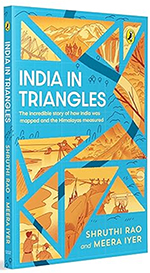
Shruthi Rao and Meera Iyer in their India in Triangles have explained in easy-to-understand language the main principles of triangulation, and how this method was used for mapping the Indian subcontinent during the nineteenth century. The difficult mathematics involved in triangulation has been simplified by Rao and Iyer and presented in a manner that would allow children (the main target-audience) as well as adults who are non-specialists to easily understand the highly technical subject. India in Triangles focuses on the principles underlying the mapping of the subcontinent through the Great Trigonometrical Survey (c.1802-1870s), and in the process narrates the history of cartography in the context of colonial India.
Some of the surveyors employed by the EIC were putting forth proposals for producing maps based on triangulation around the time that the Company established its control over southern India following the defeat of Tipu Sultan and the conquest of the Mysore kingdom in 1799. Colin Mackenzie, who was given the task of surveying the recently acquired territories in the peninsula, was one of the officials who initially suggested that triangulation was the way forward, even though Mackenzie himself was not in favour of entirely abandoning route surveys. It was another EIC employee, William Lambton, who (with Mackenzie’s support) managed to convince his superiors about the advantages of triangulation and went on to initiate the trigonometrical survey in 1802. Incidentally, Rennell was sceptical of the worth of triangulation which he considered to be a waste of resources.
The book outlines the career of ‘the shy genius’ Lambton and describes some of the difficulties he encountered at the preparatory stage of the project. This involved establishing a baseline in Bangalore (1800). The baseline, 12 km in length, was measured with a steel chain that was just 30 metres long. Consequently, the chain had to be continuously moved forward as every 30 metres were measured—not an easy task since the ground was not level for the entire 12 km stretch, and consisted of deep trenches, rocky ground and built areas of villages. Moreover, the chains had to be protected from heat to prevent the metal from expanding and thereby causing errors in measurement.
George Everest, who succeeded Lambton as head of the Great Trigonometrical Survey, speeded up the project for mapping India by organizing the survey more efficiently while adhering to the rigour with which it had been carried on under Lambton.
Simultaneously, work progressed on a related project (also initiated under Lambton), for measuring the Great Arc, the distance from the south to the north of the subcontinent to determine the curvature of the earth at the tropics. This project was completed under Everest and was an important contribution to geodesy. Another outcome of the GTS was the measurement of the highest peak on earth, Peak XV (Mount Everest). Its height was worked out by the computing wizard who was part of the GTS team, Radhanath Sikdar. Another Indian who played a crucial role in the project was its instrumentation engineer, Syed Mir Mohsin. The book also devotes space to the huge workforce that constituted the surveying teams and remain unnamed. Several delightful exercises which form part of the book show how geography, often thought to be a boring subject, can be made enjoyable.
Amar Farooqui is former Professor, Department of History, University of Delhi, Delhi.