
Saadat Hasan Manto (1912-1955), in the 42 years he lived, produced 20 collections of short stories, five collections of radio dramas, three of essays, two of sketches and a novel. He even dabbled in writing film scripts for the studio, Bombay Talkies. In his character sketch of Ashok Kumar, Manto mentions how he had once been saved by him from a rioting mob in Bombay. His most prolific period came at the end of his life, between 1951 to 1955, where due to his precarious economic condition and growing alcoholism (his family even had to admit him to an asylum), having chosen to move to Pakistan, he was literally writing a story a day!
Born into a middle-class Muslim family in Ludhiana in 1912, Manto’s early tryst with writing involved translating the works of the modern greats of short stories, the likes of Chekov, O Henry, Maupassant and Zola into Urdu. This formative exposure had a deep influence on his own style of writing. Manto took up and mastered realistic portrayals of life in all its meanness, pettiness and ugliness. He was prolific and often deliberately provocative, wrote with a certain candour, never judging, or preaching morals.
Manto’s best-known stories often deal with the events of the Partition. The tragedy of Partition, he wrote, was not that there were now two countries instead of one but the realization that ‘human beings in both countries were slaves, slaves of bigotry . . . slaves of religious passions, slaves of animal instincts and barbarity’.
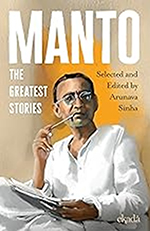
Manto: The Greatest Stories selected and edited by Arunava Sinha contains 17 stories of Manto, by eight young translators who are university students. In the editor’s note Sinha writes, ‘What makes Manto an irresistible choice for a generation glued to the screen and loath to read anything that’s not fan fiction? What makes young adults among each succeeding generation of Indians read Manto? What draws these seventeen to twenty-one year olds to stories written during their grandparent’s childhood and teenage years?
The selection of stories in this collection is a mix of well-known stories pertaining to the Partition, as well as stories that depict violence and sexuality. Topics in Manto’s time which were not just controversial but largely seen as taboo by society in general. The known suspects that appear in almost all Manto ‘greatest’ selections are there, like ‘Khol Do’, ‘Buh’, ‘Dus Rupay’, ‘Thanda Gosht’ and ‘Khushia’.
Manto’s protagonists are the most marginalized members of society, portraying life in its very base and ugly form. The historian Ayesha Jalal in her book, The Pity of Partition: Manto’s Life, Times, and Work Across the India-Pakistan Divide wrote: ‘Whether he was writing about prostitutes, pimps or criminals, Manto wanted to impress upon his readers that these disreputable people were also human, much more than those who cloaked their failings in a thick veil of hypocrisy.’ This emphasis on human dignity and the resilience that the marginalized and oppressed demonstrate is Manto’s greatest connect with readers across generations, and that is reflected in the choice of stories that the young translators bring to us in this collection.
For instance, in ‘Dus Rupay’ (Ten rupees), Manto addresses the grim realities of poverty and child prostitution. However, he eschews the typical stereotyping of the child prostitute as a poor sex worker with no agency. Sarita, who is forced into the trade by her mother, is aware of her professional requirement to her clients. She surprises everyone, especially the three rich men who take her out for a whole day to have sex. Because she did not have any sex with them, she returns their ten rupees indicating to the astonished men and readers that she was well aware of what the young men had come for.
‘Badshah ka Khatmat’ (The End of a Reign), a short story by Manto, was adapted by Mrinal Sen in his Bengali movie Antareen (confined). Manto explores the complexities of human connection and intimacy. The telephone acts as a device that allows the characters to build a relationship free from the physical realities and societal judgments. This intimacy, however, is fragile, as it thrives on anonymity. The writer’s dread of meeting the woman in person reveals a universal fear: that reality will not live up to the idealized fantasies we construct in our minds.
The 17 stories selected in this collection give the reader a deep insight into Manto the person and his writing. Themes which have a resonance and a deep relevance in the world we live in today.
Bharat Kidambi is a Bangalore-based entrepreneur.