
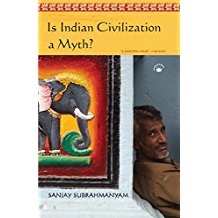
Is Indian Civilization a Myth? is a collection of articles by Sanjay Subrahmanyam, most of which have been previously published in Outlook, India Today and the London Review of Books. Also included are two unpublished pieces that are autobiographical in nature, one piece originally in French and the other an interview which was conducted in Portuguese.
An insider to the debates on Indian history and historiography and familiar with Subrahmanyam’s academic work, when addressed in this collection, may well remain unmoved from a position already adopted. For instance, the controversial article in Outlook debating Ashis Nandy is a case in point that sharply brings out the difficulties that attend to the writing of history at a time and place like India where it is most alive.
While Subrahmanyam may well be appreciated for demanding a rigorous documentation of arguments that are ostensibly made on historical grounds, what is less clear is the function of a historical argument in analysing contemporary reality. Subrahmanyam does not feel that historians are equipped to critique nationalism (p. 7); but is the historian’s task then merely pedagogical i.e., to correct others when they turn to history? And how is such correction to be evaluated when confronting Nandy for whom the very basis of such an endeavour (history as a method) is suspect and for whom an erroneous use of a category—such as the concept-term convivencia as pointed out by Subrahmanyam—in such terms may not be fatal to the point being made? Ultimately what is of interest is that it is not only Subrahmanyam the scholar who is troubled by Nandy’s use of history, but also the scholar-historian’s political antenna which detects what it sees as a curious complicity between the latter’s positions and those of the Hindu Right. While this is not the place to enter the fraught nature of a concept-word (history) that designates both referent (source/event) and sign (method) it might well be the ground for profound if ultimately incommensurable swordplay. Much of Subrahmanyam’s scholarship is fruitfully brought to bear on contemporary issues and yet the precise relationship between history as method and the contemporary or history and politics is rarely thematized as such; it is just about acknowledged in flashes of introspection, as when he responds in an interview, ‘No one can write a history that is totally devoid of political implications. However I try to draw a distinction between my more popular and my more scholarly writings, saving explicit political arguments for the first. Sometimes, things become blurred though’ (p. 245).
The bulk of the articles collected here were earlier published in the London Review of Books. The reviews of grand theses on diverse topics such as Empire, the historical tragedy of the West, the Great Man view of History and Thugee in Colonial India and Civilizations and terrain interweaves the weight of scholarship with the leisurely easy amble of the essay, allowing both the layperson and the cognoscenti to savour the prose, to taste as it were. The critique of Ramachandra Guha’s India After Gandhi, even if undertaken sympathetically, is made effective by using Eugene Weber’s classic Peasants into Frenchmen, as a foil. Subrahmanyam makes the case that it is the lack of a central argument—or even thrust—to Guha’s sprawling canvas that necessitates a focus more on character-sketches (where there are clear favourites such as Jawaharlal Nehru) rather than probing questions, such as the striking lack of socio-economic mobility in Independent India or the surprising lack of large scale violence in the country among non-western societies as compared to other regions whether they be Latin America or China.
A thread in the collection has much to do with the diversity of languages in the world and the diversity in historical experiences. Subrahmanyam’s own academic work that stretches from the Portuguese to the Ottoman to the Mughal Empire makes him the right person to evaluate works of global ambition. Here his scepticism towards the arguments put forward by John Darwin in After Tamerlane: The Global History of Empire, is driven not only by the weaknesses found in the latter’s conceptualization of empire, but also by an appreciation of the diversity of form that go under the label of empire when indeed a range of political formations claimed and disclaimed the category in its long historical career. Subramanyam illustrates his arguments by, among others, vignettes from his chest of historical memory such as the story of the Ottoman traveller Abdur Rahman bin Abdullah al-Baghdadi al-Dimashqui who in his travels to Brazil refrains from considering the latter an empire, the word having such distinct meanings across historical and geographic space. Historical detail becomes thus a way to imagine worlds and contest homilies about ordinary everyday words and terms, and shines a light on the hollowness of much Euro-centric myth that has almost become second nature to the professional and layman alike. As Subrahmanyam argues, it is telling when there is a wider discrepancy for the publisher’s demand for great big tomes (often executed on fragile ground) that serve history in large scoopfuls about the world at large and its millennial trajectories while the academic monograph is expected to be more and more specialized without even a modicum of scope or ambition beyond its archival site.
An essay on the so called Cambridge schools and Subaltern Studies gives us hints to the various twists and turns of historiographical sojourns across institutional sites and oceanic barriers. It is not that one would not have disagreements and even serious reservations about comments that appear at times to be stretched to the point of simplification: such as when Subramanyam writes that ‘Guha and others’ of the early volumes of the Subaltern School, rather than emphasizing that the use of the vernacular ‘simply pointed out that even official British sources could be read in a manner sympathetic to subaltern classes’ (p.168). Much on the ambitions of those writings regarding historical narrative and archival authority are submerged in this rather tepid statement that has more the look of a throw away remark, only that it is at the centre of the article. Even so the essay is a delightful read because of the canvas, teeming with the analysis of odd and abandoned historiographic conjunctures, the relationship between institutions and intellectual fashions and the nitty-gritty and at times cliquish politics of journals and citations.
There are three pieces which take on the literary greats, Gabriel Garcia Marquez, Salman Rushdie and V.S. Naipaul. While Subrahmanyam’s distaste for the last is undisguised, his responses to Marquez and Rushdie are more complex. The essay on Marquez is written through a review on a recent biography, but becomes an occasion for an examination of what is taken to be Marquez’s unconcealed, almost unashamed, desire for attention and fame. With Rushdie Subrahmanyam’s intermittent sympathy looms even as an illuminating contextuali-zation of Satanic Verses within the then new work on early Islamic history—John Wansbrough, Michel Cook and Patricia Crone—that challenged orthodox self representations takes place. Although, here Subramanyam has no patience for the sections on the text which ostensibly recreate the times of the prophet, it is surprising that he spends so little time on the almost prophetic figure of the poet character Baal or the telling epigram from Defoe: ‘Satan, being thus confined to a vagabond, wandering, unsettled condition, is without any certain abode; for, though he has, in consequence of his angelic nature, a kind of empire in the liquid waste of air, yet this is without any fixed place, or space, allowed him to rest the sole of his foot upon.’ One almost wished for a more sustained engagement with questions of literature, literary freedom and religious-political authority.
An almost charming section in the collection is the autobiographical portrait of a young Subrahmanyam, first studying at the Delhi School of Economics and then working away through the archives and living the life of a young expatriate researcher in Lisbon and Paris in the 1980s and 1990s. For anyone outside of the academic world, the academic might appear as an exotic species rivalling the sea anemone, and Subramanyam’s memoirish prose allows one a peak into her marine habitat where obscure delights in arcane archives intermingle with the minor travails and successes of social life. Life in D School relives the exuberance of the first blush of scholastic life but the essay is also an implicit commentary on our higher education in the social sciences and the humanities. In Lisbon the everyday encounters, trials and triumphs of historical research in a new place are brought to life, while the piece on Paris contains an interesting sociological commentary on what appears as the Parisian fascination with the glamour of crime. The Vajour case is discussed—where Nadine Vaujour masters the skills of flying a helicopter to successfully rescue her beau from the state prison in broad daylight—as a case in point. The sociological commentary touches on the nature of city life and urban community, the racial diversity and changing patterns of migration with the almost perceptible increase in denizens of South Asia, and their faux representation in, among other places, the cultural representations of the city emanating from Hollywood.
The weakest essays appear to be those that directly comment on the contemporary such as the one in India Today where one argument, among others, concerns the necessity of corporate philanthropy in contemporary India a la the Rockefellers and Warren Buffet in the light of ‘liberalization’. However, one might argue that liberalization is less ‘fundamentally…a process [which] entails [is] the reduction of the role of the government in economic and social terms’ (p.193) and more a subsidizing of corporate interests in their rapacious acquisition of land and other natural resources, often combined with the militarism that one sees in Central India; if the many scams of the last few years are anything to go by the so called ‘licence raj’ appears a piece of a bucolic past. A quick segue to Subrahmanyam’s scholarly oeuvre as they inform these more ‘popular’ pieces may reveal the implicit critique of the majoritarian identity politics of today rather than structural economic disparity.
If this is an unusual collection it is not only because an unusual combination of literary skill and great learning is brought together with flair. In India where academia and the world outside seem separated by a galactic divide Subrahmanyam’s essays must count as a heroic and worthy exercise in space travel. This is why even at times when the prose carries an almost polemical edge bordering on the tendentious they must be welcomed for what they provoke and what they teach.
Rahul Govind is a Fellow at Indian Institute of Advanced Study, Shimla.
コメント