
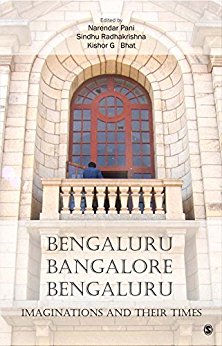
Narendar Pani
Narendar Pani, In his introductory essay, states that the book was compiled in the wake of an absence of ‘a collective effort to recognize. . . (the city’s) past (4).’ After noting that a dialogue between ‘the present and the past’ . . . has never gathered momentum in Bengaluru,’ he offers an intriguing explanation for it…
Prasenjit Bose
One of the imperatives of transformative politics aiming for radical change has been to overcome the insurmountable complexity of pursuing praxis with a singularity of purpose, and yet not abandon critical enquiry into the philosophical presuppositions guiding that practice, as much as contributing to the philosophy itself…
Rajeev Bhargava
Democracy and its accompanying value of secularism has been a target of heavy criticism for both academic and non-academic sections of India. Along with their practice, the very ideals are now questioned as undesirable and deeply flawed. Scholars like Ashis Nandy, T.N. Madan and Partha Chatterjee have come…
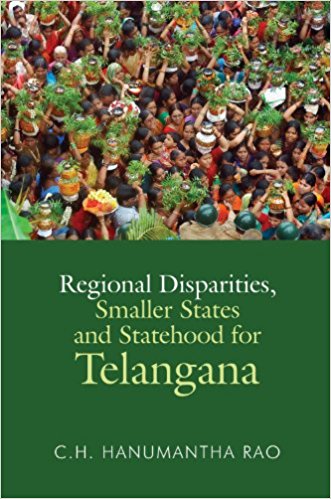
C.H. Hanumantha Rao
In this slim book noted economist C.H. Hanumantha Rao brings together his eight essays on regional disparities, smaller states and Telangana written at different points of time since 1969 with an Introduction and an Epilogue contextualizing them and observations on recent developments in Telangana…
Raka Ray
There used to be a children’s game played by seven or eight year olds long ago, not really a game but a kind of verbal oneupmanship that seems so cool and clever at that age. The first step was to look for a suitable victim, an innocent new to the game. Then you had to get your victim to start off by saying…
Amartya Mukhopadhyay
Rabindranath Tagore, who famously declared that he was ‘nothing but a poet’, is read in this book for anything but his poetry. ‘Much of Tagore’s central claim to greatness lies in his social thought’, the back cover of Amartya Mukhopadhyay’s comprehensive volume declares, and even a cursory inspection will show…
Reba Som
Reba Som’s book on Rabindrasangeet appears at an interesting, if not a decisive time, in the history of this musical genre. For many years now, Rabindrasangeet has provided a very modern sense of belonging to Bengalis. The ineffable but emotionally charged lyrics and the distinctive tunes with their stretched accents…
Doris R. Jakobsh
This is an important scholarly work within the broader framework of sociology of religion, where Indian sociologists like M.N. Srinivas, T.N. Madan, Dipankar Gupta and Rowena Robinson have contributed over the years. The concepts discussed had been ethnicity, pluralism, religious institutions and religious texts…

Prashanto Kumar Chatterji
In his insightful essay Writing Political Biography, Rae Wear claims that there is a little bit of autobiography’ lurking beneath the surface of every biography where its foremost reflection is through the choice of subject. While some biographers may be drawn to subjects they admire, others are led by the curiosity to understand…
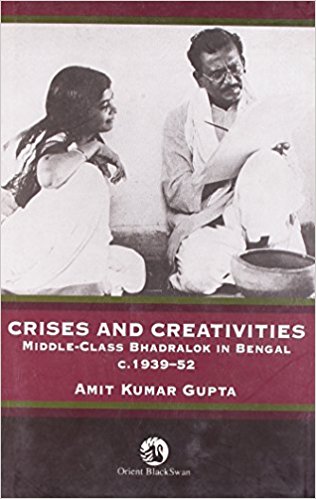
Amit Kumar Gupta
Crises and Creativities is a book that can be described in many ways. At one level, it is a book about the (Bengali) middle class. At another level, it is a book about vernacular Marxism, if such a term be permitted. At yet another level, this book is about a critical and still under-researched time of Indian history—the 1940s…
Genevieve Debais
‘Recosts et Contes Popularies dli Berry’ is a charming collection of popular folk tales, legends, patriotic and sentimental songs and even local dances. Genevieve Debais and Michel Valiere have put on record some of the traditions and customs of a region which is in the heart of central France.
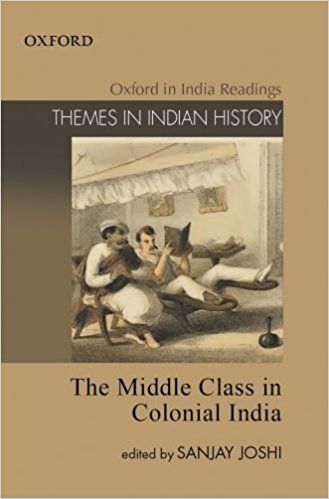
Sanjay Joshi
The role of the middle class in transforming India is being discussed and debated from the late 19th century. In the first two decades of Independence historians gave a lot of attention to the role of the middle class in the national movement, but from the 1970s the focus shifted to the peasants and subalterns…
Nasira Sharma
All translations cut both ways. While, on the one hand, they rarely capture the nuances or flavour inherent in the original or even measure up to the fervour enshrined in it, they do serve in reaching out to a wider audience. This, latter aspect is especially and significantly heightened when the original in question is starkly socio-political in its content and has, as one of its primary aims, the creation of a widespread awareness of an unjust socio-economic and political system and its destruction.
Shruti Kapila
The volume under review is a reprint of a special issue of the journal Modern Intellectual History which came out in April 2007. As Kapila notes in the introduction, intellectual history as a genre has not quite developed in the field of Modern Indian History inspite of the pioneering work of Eric Stokes and Ranajit Guha, more than half a century ago…
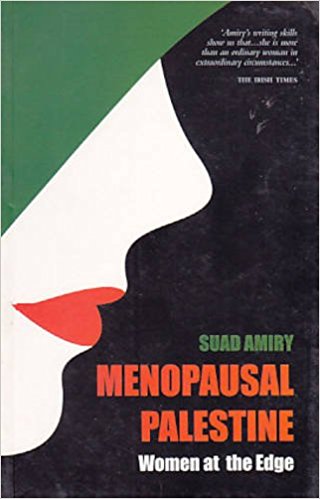
Suad Amiry
This is how Suad Amiry ends the preface to her book, Menopausal Palestine: Women on the Edge. So Amiry puts all the ingredients together, adds dollops of humour and irreverence, and succeeds in publishing an entertaining and insightful book on the lives of women in conflict-ridden Palestine…
Keki N. Daruwalla
1981
In September 1968, the need for an Introduction to his collection of essays and reviews persuaded David McCutchion to examine the state of the criticism of Indian writing in English. His assessment was characteristically restrained but exacting: ‘the critical tradition in India is weak,’, ‘Lack of critical, especially self-critical discrimination is certainly a feature of this situation’, ‘on the one hand it (takes) the form of dismissive contempt.
Maloy Krishna Dhar
Maloy Krishna Dhar’s Train to India may be read as an antithetical account of another perilous journey described by Khushwant
Singh in his Train to Pakistan—both books offering harrowing insights into the colossal human tragedy that engulfed two countries in the wake of the partition of India…
Ali Sethi
2010
Books by young men who have studied abroad always seem to begin in aeroplanes. The moment you read the first lines—a description
of the view from a window as a flight to Lahore comes in to land—it is evident that The Wish Maker is unlikely to defy the conventions that have sprung up around what is now a flourishing subgenre: the novel of explanation, in which a young Indian or Pakistani sets out
to somehow explain to a newly-interested world the nuances of his country’s past and present, with its coming of age neatly coinciding with his own.

Agha Shahid Ali
When I met Agha Shahid Ali’s father Agha Ashraf Ali a few months back, he told me about the latest collection of ‘Bhaiya’ (as the poet was lovingly called by his family) that had already come out in the US and was now being brought out by Penguin in India. He was excited about the launch of this collection…
Gail Minault
In a chapter not quite characteristic of her general scholarly procedure as a historian, Gail Minault in the middle of this book cuts loose to attempt a sustained comparison between what she calls ‘the Delhi Renaissance’ and the far more lauded ‘Bengal Renaissance’—which should perhaps be similarly…