

By Shehnab Sahin
‘In 2018, at a meeting in Meerut in the northern State of Uttar Pradesh, the chief of Rashtriya Swayamsevak Sangh (RSS), Mohan Bhagwat addressed one of the largest conclaves of RSS workers on a crisp February morning. In his long address to more than a thousand people, he said, “In India, one may follow a different eating habit, way of worshipping gods, philosophy, language and culture.
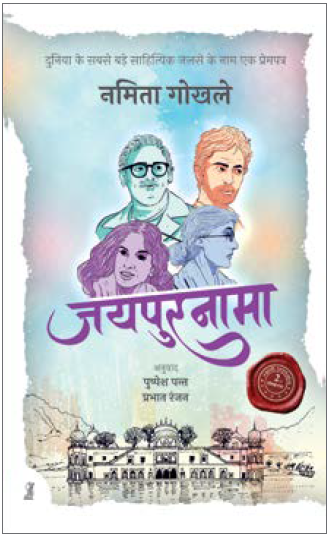
It began with a well-executed burglary.’ The lively poet at the festival is ‘lost and disconsolate’ when he sees the literary world ‘full of privileged hierarchies and lucky chances, of winning streaks and downward spirals of defeat and heart break.’

By Sanjoy K. Roy
He has travelled widely, cavorted with celebrities, vacationed frequently and consumed copious quantities of vodka. The text makes little attempt to temper this presentation, leaning into the spectacle of a life lived large. But it unfortunately becomes the most glaring issue in the book—the repetitive references to luxurious hotels and expensive food and brands. It is tiring and begins to feel shallow rather quickly. In ‘An Accident Foretold: Goa’, their hotel’s name—Taj Holiday Village—is cited so frequently that it begins to feel less like a setting and more like a refrain.

By Gautam Bhatia
The original Panchatantra story has the typical lion waiting to devour a jackal. It’s a play of wit between the King of the Forest and the most wily creature in the jungle. In Bhatia’s modern version, the lion does not enter the fragile cave of the jackal because he may simply bring down the structure, so he devices a ‘plan’. Since he is the chief of the ‘Jungle Planning Commission recently renamed Neeti Vanyog’, the members of the King’s Cabinet round up a random bunch of painters, art collectors, print makers, and start an Art Camp.

By Shefalee Vasudev
Vasudev dissects how Indian leaders craft public image through clothing. From Prime Minister Modi’s signature kurtas to Kangana Ranaut’s elegant sarees, politicians dress for the public in ways the public rarely does. Is their apparent indifference to fashion trends genuine, or calculated to suggest that priorities lie beyond style, with the ‘real issues’ of the public? Indian netas favour ‘traditional’ handloom, cotton, and khadi to project authenticity. But is it a genuine connection, or hypocrisy for voters who can no longer afford these fabrics?

Sukrita Paul Kumar and Savita Singh
Seven Leaves, One Autumn: the very title is poetic, evoking the vivid shades of yellow, orange and red through which autumn leaves pass as they turn from green to brown. This collection brings together the work of seven award-winning women poets: Zohra Saed from Afghanistan, Julie Boden from Britain, Clara Janes from Spain, Kishwar Naheed from Pakistan, Ute Margaret Saine from the USA, and the two editors, Savita Singh and Sukrita Paul Kumar, both from India.

By Nicholas J. Abbott
Subsequently, Bahu Begam consented to abandon the remains of her wealth to the Company, and emerged as one of the largest individual investors in British India’s public debt. This action demonstrated not only the willingness of the Company to reinstate the Nawab but also its anxiety to be recognized as a sovereign state in the South Asian political order, and its dependence on the financial and political capital of women like Bahu Begam.

By Faith K. Beasley
In retrospect, la Sabliere appears as a twentieth century socialite, who is a patron of writers and intellectuals, academics and statesmen. But the salon presided over by aristocratic women became the shining example of French intellectual life in the seventeenth century. Neither historians in general, nor historians of social trends and ideas, seem to focus on this aspect.

By Phil Craig
The fact that Bose, in his death and after the defeat of the honourable INA, united Indians across the political spectrum is noted in glowing terms by Craig. The second section has interesting narrations about individuals and various Allied armies who rallied ‘round the flag’, meaning the Union Jack. The story of the immense sacrifices made by men, officers and civilians in the theatres of war and war crimes, including the horrors of Belsen in the West and Borneo in the East, is told in a prose which makes the book unputdownable.

By David Boyk
It was here that wealthy traders and aristocrats lived. Later, they served as indispensable intermediaries between the colonial state and the broader population in Patna. However, the colonial state eventually developed the Danapur and Bankipur regions, away from the old town, also known as Patna city. Present-day Patna developed around Bankipur.

By Raman Mahadevan. Introduction by Gurcharan Das
And the collapse came in the 20th century. The depression of the 1930s was the first serious blow. While the larger business houses were able to stay afloat, the medium and small firms suffered a near collapse. Next came World War II and the Japanese invasion.

By Girija Joshi
The text contains an extensive account of the manner in which the Kalsia zail (retinue) was organized as a raiding and soldiering band with sections on its allies (hamrahan, tab’in) and relatives. Disputes over succession arising out of a range of superior and inferior conjugal unions (karewa, chadar dalna, shadi, byah) form an important part of this study. Women in the roles of wives,

By Karma Lekshe Tsomo
Chapters focus on early Indian traditions, followed by a region-specific treatment of South and Southeast Asia, East Asia, inner Asia, the West, and Women’s ordination across cultures, ending with a chapter self-explanatorily titled ‘Grassroots Revolution: Buddhist Women and Social Activism’, which is an account of women in what is called ‘engaged Buddhism’. Blurbs by eminent Buddhist scholars such as Jay Garfield, Jose Cabezon, and Paula Orai situate it within academic discourse as a valuable resource.

By Louise Tillin
A new social and political class dissociated from the Congress and with considerable political clout was emerging in rural areas. As a result, policies like the Employment Guarantee Scheme (EGS) and the Integrated Rural Development Program (IRDP) emerged during this time.

By Abhishek Choudhary
In his own way, though, he was defying stereotypes associated with pracharaks. He had little by way of a formal education’ (p. 324). It was Advani who persuaded Vajpayee to send this pracharak from a little room of the Party office in New Delhi as Chief Minister of Gujarat. Second, the author’s narrative of Vajpayee’s indifference towards the Ayodhya issue, even with the ongoing Allahabad Kumbh Mela.

By Sudhir T. Devare
In these four decades plus, the country has experimented with democracy which was short-lived. It ‘remains a grey zone of uncertainty’. The ‘people deserve a better future’. Will that ever come to pass, wonders the author. Korea appears to be the author’s soft spot. Again, with good reason. Unlike Myanmar, South Korea has moved, in around the same time period, from being a despised dictatorship to a robust democracy. In 1983, in an infamous attempted assassination of the then President, the Korean Foreign Minister who had earlier been Ambassador in India was killed. Korea’s economic growth is exemplary.

By Sohail Hashmi. Illustrated by Pervez Rajan
The Great Stupa at Sanchi is presented not via dates or dynastic connections, but through physical experience encompassing its dimensions, curvature, and routes. Concepts such as the stupa as a commemorative structure, the practice of circumambulation (parikrama), and the symbolic arrangement of space along cardinal directions are described contextually. The absence of anthropomorphic representations of the Buddha in early reliefs becomes understandable through narrative exchange rather than doctrinal explanation.

By Joerg Esleben with Rolf Rohmer and David G. John
Bennewitz records in great detail the day-to-day progress of his work in the many regions and languages of India that he engaged with. After his death in 1995, Mertes handed his entire archive—the letters, of course, but also a large number of documents and other materials—to an association of his friends, who then set up the Fritz Bennewitz Archive in Leipzig.

By David Matthews
Notwithstanding the struggles waged by the British working class against Capitalism, this work could have deployed a more analytical approach to the history of colonialism and its relationship with the development and the evolution of not only the labour, but also the material origins of that robust post-War welfare state which perhaps would have been a nonstarter, had it not been for the colonial legacy.

By Manish Gaekwad
It is guided by precisely this impulse that Gaekwad repeatedly reframes his key life moments through the visual grammar and narrative idiom of Bollywood cinema as a ‘primal source of imagination’ (p. 46). Presenting his life and experiences through this cinematic lens, he draws upon songs, dances, and the attendant celebrity culture of Hindi mainstream cinema to foreground and navigate his complex familial reality. The impact of cinema is evident in his personal details: