
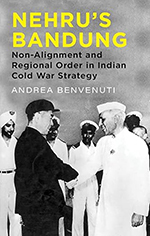
By Andrea Benvenuti Hurst,
Like Nehru, Mao also came to power in 1949 convinced that he needed 15-20 years of peace in Asia to develop his own country. Mao told Stalin precisely that at their first meeting in Moscow in December 1949, and Stalin promised that he should be able to ensure that. But Nehru and Mao clearly differed on how peace was to be secured. Within six months of that conversation with Stalin, Mao and Kim Il Sung were seeking Stalin’s approval to reunify Korea by force of arms, and came close to doing so.
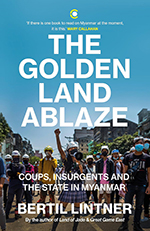
By Bertil Lintner
One was the reference to the strong defense mounted by Suu Kyi as the country’s then leader in December 2019 at the International Court of Justice at The Hague disputing the charge of genocide against Myanmar’s armed forces for their actions against the Rohingyas. The author notes that the people of Myanmar were full of praise for her performance, even as much of the outside world was outraged
By David C. Engerman
In contrast, Jagdish Bhagwati was one of the leading global defenders of trade liberalization. While Sen worried about social justice, Bhagwati argued that open markets and rapid growth would lift all boats. His influential Planning for Industrialisation co-authored in 1970 with Padma Desai, critiqued the inefficiencies of India’s import substitution strategy and the ‘Licence Permit Raj’ that was stifling rather than promoting industrial growth. He has regularly and publicly clashed with Sen over the proper sequencing of reforms.
Compiled by Y.V. Reddy with Ravi Menon, Shaji Vikraman, and Kavi Yaga
Part V of the book on ‘Media’ has five articles where the authors refer to themselves as ‘journalists’ rather than media persons; each piece contains fascinating details of their encounter with people and events in all walks of life, including challenges that had to be resolved internally within the organization and those encountered in the course of one’s work journey.
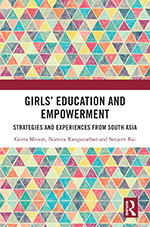
By Geeta Menon, Namita Ranganathan and Sanjeev Rai
The book has been written taking this as the backdrop. The authors pose some questions in light of the need for understanding the initiatives taken and the strategies used in a nuanced and detailed manner. Some of these questions pertain to: what were the principles and assumptions that guided them? How was social change mediated? What contextual strategies were devised for the continuity and safety of girls’ education? And how was gender identity reconstructed?
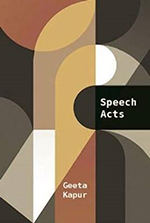
By Geeta Kapur
2025
Kapur might carp at my introduction for, as she tells Saloni Mathur, ‘I describe myself quite simply as critic and curator. “Art historian” is not a correct academic description for me, and I am not comfortable with the self-attribution of a theorist. Although the term “critic” seems now reduced to the blogger or the newspaper columnist, in the early 1960s, when I was a graduate student in New York, it was starkly different.

By Rachna Singh
Photography happened rather late in Rai’s life. He had started as a qualified engineer and had dabbled in a couple of government jobs, but his restless mind was in search of something else. He constantly recalls his mother’s saying in Punjabi which means, ‘If we do not work dedicatedly, we will not achieve the heights of heaven.’ Encouragement by his elder brother S Paul who was an established photojournalist and the urge to do something different brought about the change Raghu Rai was looking for.
Rama Kant Agnihotri challenges monolingual biases in his analysis, focusing on the phenomenon of redundant compound formations in Hindi. Through examples like dhan-daulat (wealth-wealth) and chai-paani (tea-water), he explores the layered social and historical meanings embedded in everyday expressions.

Edited by Kanika Singh
Documenting their experiences of running the Academic Bridge Programme at Ashoka University, Neerav Dwivedi and Jyotirmoy Talukdar deliberate upon creating a democratic space in a multilingual classroom. They dwell on everyday pedagogic processes and convert them to potential practices to challenge hierarchies. A simple act of asking a question in class is often marked with a strain of apology.

By Gijubhai Badheka.
A few key observations of the methods that stood out for me are the unconventional ways to engage students in the classroom. Laxmirambhai starts with a story instead of teaching straight from the syllabus. Games can break the monotony of a classroom, making everyone participate. With some rules, playing games using some concepts can lead to real education. ‘Games are a form of true education,’ says Gijubhai.

By Mary E. John
In particular, this review remains faultily quiet about the fascinating analyses presented in the book on the prolonged (nineteenth- and twentieth-century) history of child marriage in India and its differential regional framings within the national universe; the ebb and flow of social reform in colonial and post-Independence India swirling around the woes of child brides and child widows, and the intermittent engagement of feminist research and action with the practice of child marriage.

By Madhavi Desai CEPT
The frontages of the houses were beautifully adorned, with colonial influences evident in columns, pediments, capitals, arches, and cast-iron grilles. Intricately carved zarookhas (projected balconies) integrated indigenous architectural elements. Each floor of the façade featured contrasting designs, and houses—particularly in Siddhpur—were painted in varying pastel shades to break visual monotony. Raised on a high plinth, the main door was accessed via a short flight of stairs, not unlike a stoop.
That is why, when Gokhale says, ‘You spoke of the university as a liberal space. My experience of teaching was different—it was not a liberal space at all. My problem is that the educational system, as it operates in many parts of this country, is extremely feudal,’ it shows the hurdles on the way to freedom. The intolerant state at the top of the power pyramid is safely ensconced in the middle of little tyrannies operating at various levels.

Edited and Introduced by Ather Farouqui and Anjuman Taraqqi
More than a scholarly revelation, the reintroduction of Hafeezuddin Ahmad’s manuscript calls for an ethical reckoning with the historiography of Delhi. The literary fame and scholarly prestige enjoyed by figures such as Sir Syed must now be revisited in light of the sources they used—and possibly co-opted.

By Eugenia Vanina
Ever optimistic, Vanina records that there may be ‘differences and even conflicts, but on the majority of events and actors of the past there is usually a national agreement’ in favour of ‘mutual respect for differing feelings and affiliations’ (pp. 338-39). This is true for politics and history on an international scale.

By Rahul Markovits
Nevertheless, they were able to take advantage of the culture of ‘hospitality’ which had been encouraged by the post-1789 government policy of honouring misfortune (honore le malheur) by way of hospitality (à titre d’hospitalité), which was also decreed by the Comity of Public Safety when granting assistance to ‘Ahmad Khan Indian’.

By Ghee Bowman
The soldiers were part of the 2.5 million-strong Indian Army. They were taken prisoners, as the war progressed, in theatres in east and north Africa, the Mediterranean, Europe and on the high seas. They endured five years of incarceration. Included in them were the Viceroy Commissioned Officers (VCO), a category so peculiar to the Indian Army that the confused Germans had to enquire from the British whether they were to be treated as soldiers or officers! Another oddity was that the earliest, and often the longest-serving POWs were not even soldiers.

By Harald Fischer-Tiné
2023
Rather than limiting itself to the colonial period, the study deliberates at length the socio-economic and political conditions of the YMCA in the post-1947 era. The author highlights the role that the institution played during the Cold War period.

By Caleb Simmons
Mysore’s association with a buffalo myth dates back to the latter half of the first millennium. The Wodeyar kings reinvented this myth in the seventeenth century by associating the local female deity with the Pauranic legend of the Goddess slaying Mahisha, the buffalo demon. This foundational myth concerning the Goddess and the city has remained in the popular psyche ever since (pp. 29-30).

Edited by E.V. Ramakrishnan and K.C. Muraleedharan
The compilation addresses different aspects of Vijayan’s oeuvre, including his literary works, his contributions to political thought, his engagements as a cartoonist, and his role as a translator. In this introductory chapter, EV Ramakrishnan delves into the multi-dimensional persona of Vijayan, analysing how the writer is defined as a ‘critical insider’ within the socio-political and cultural contexts of postcolonial India.